Global web icon
stackoverflow.com
https://stackoverflow.com/questions/19855497/what-…
What does <> (angle brackets) mean in MS-SQL Server?
nvl is not a SQL Server function. <> operator means not equal to in MS SQL. It compares two expressions (a comparison operator). When you compare nonnull expressions, the result is TRUE if the left operand is not equal to the right operand; otherwise, the result is FALSE.
Global web icon
mssqltips.com
https://www.mssqltips.com/sqlservertip/7684/sql-co…
SQL Comparison Operators Examples and Sample Code
Learn about the different types of SQL comparison operators like =, >, <, and more and how these can be used to narrow down query results.
Global web icon
w3schools.com
https://www.w3schools.com/sql/sql_operators.asp
SQL Operators - W3Schools
Well organized and easy to understand Web building tutorials with lots of examples of how to use HTML, CSS, JavaScript, SQL, Python, PHP, Bootstrap, Java, XML and more.
Global web icon
sqltutorial.org
https://www.sqltutorial.org/sql-comparison-operato…
SQL Comparison Operators
This tutorial introduces you to the SQL comparison operators and shows you how to use them to form conditions for filtering data.
Global web icon
techonthenet.com
https://www.techonthenet.com/sql/comparison_operat…
SQL: Comparison Operators - TechOnTheNet
In SQL, there are two ways to test for inequality in a query. You can use either the <> or != operator. Both will return the same results. Let's use the same suppliers table as the previous example. Enter the following SQL statement to test for inequality using the <> operator: OR enter this next SQL statement to use the != operator:
Global web icon
tutlane.com
https://www.tutlane.com/tutorial/sql-server/sql-co…
SQL Comparison Operators (Equal, Not Equal, Less than, Grater ... - Tutlane
In SQL, the comparison operators are useful to compare one expression with another expression using mathematical operators like equal (=), greater than (>), less than (*), greater than or equal to (>=), less than or equal to (<=), not equal (<>), etc. on SQL statements. In SQL, we have different types of comparison operators available those are.
Global web icon
microsoft.com
https://learn.microsoft.com/en-us/sql/t-sql/langua…
Comparison Operators (Transact-SQL) - SQL Server | Microsoft Learn
When SET ANSI_NULLS is OFF, the same rules apply, except for the equals (=) and not equals (<>) operators. When SET ANSI_NULLS is OFF, these operators treat NULL as a known value, equivalent to any other NULL, and only return TRUE or FALSE (never UNKNOWN).
Global web icon
newtum.com
https://blog.newtum.com/sql-operators/
SQL Operators Tutorial: Understanding Comparison, Logical, and Pattern ...
SQL operators are essential for performing queries and filtering data efficiently. They help compare values, apply logical conditions, and match patterns in databases. This guide covers comparison operators (e.g., =, >, <=), logical operators (AND, OR, NOT), and pattern matching operators (BETWEEN, IN, LIKE) with examples.
Global web icon
geeksforgeeks.org
https://www.geeksforgeeks.org/sql/comparison-opera…
SQL Comparison Operators - GeeksforGeeks
SQL Comparison Operators are used to compare two values and filter the result set based on a specific condition. Used in the WHERE clause to filter records based on conditions
Global web icon
tutorialgateway.org
https://www.tutorialgateway.org/sql-comparison-ope…
SQL Comparison Operators - Tutorial Gateway
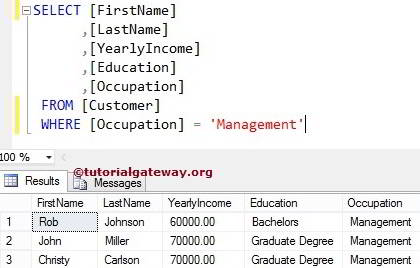
In SQL Server, we can use these comparison operators (=, <>, >, <, <=, and >=) inside the WHERE clause or HAVING clause to filter the data. It means the SELECT statement will only retrieve records that meet the given condition on the right side of the comparison.